

National survey reveals widespread burden of allergic diseases across Australia
- Published
- Tuesday, April 14, 2026 - 9:00 AM
The prevalence of allergic diseases across Australia has been difficult to quantify, but a new study published in Clinical and Experimental Allergy provides the most comprehensive picture to date, highlighting allergic diseases as a significant and ongoing public issue.
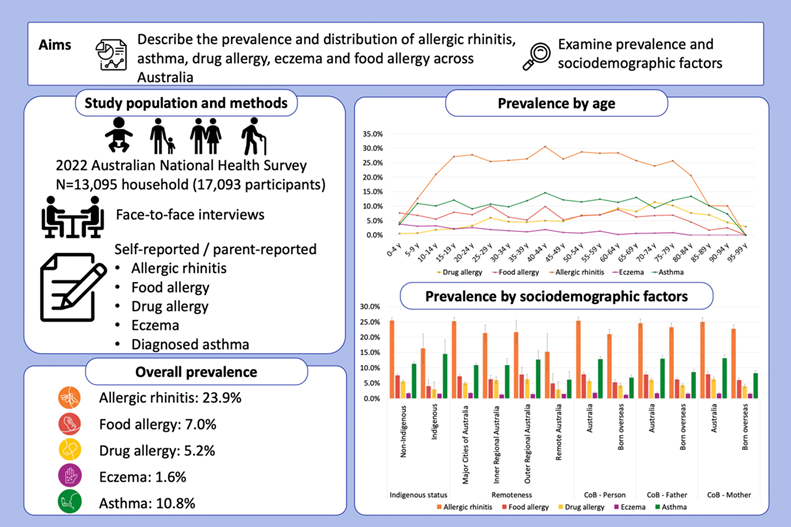
The study led by experts from the National Allergy Centre of Excellence (NACE) and the Murdoch Children's Research Institute (MCRI) analysed data from the 2022 National Health Survey, Australia’s largest population-based health survey. The survey randomly selected a sample of 13,095 households, representing 17,093 participants living in private dwellings across all Australian states and territories. Participants completed detailed questionnaires via face-to-face interviews.
For the first time, this study reveals national-level self-reported prevalence estimates for five major allergic diseases including allergic rhinitis, food allergy, drug allergy, eczema, and asthma It also explores how allergy prevalence varies across key sociodemographic groups.
Key findings of this study revealed that:
- Nearly one in four Australians have allergic rhinitis
- One in ten Australians have asthma
- Seven per cent of Australians have food allergy
- Five per cent report drug allergy
- Prevalence varies significantly by age, state, and region of birth
- Allergic diseases were reported less frequently by Indigenous Australians
 Lead author Dr Yichao Wang, Research Officer, NACE Population Health Research Program, said the findings provide an important baseline for understanding the scale of allergic disease in Australia. “As the first national snapshot, our study reported the national prevalence of five allergic diseases in Australia and how these vary across population subgroups, while recognising the inherent limitations of self-reported survey data.” Dr Wang said.
Dr Wang noted that the study also underscores major gaps in how allergic diseases are currently monitored at the national level. “To truly understand the prevalence and distribution of allergic diseases across the lifespan and sociodemographic groups, there is a critical need for objective, clinically validated population‑level data, rather than reliance on self‑report alone,” she said. 
The authors also highlight an important omission in the National Health Survey: insect allergy. “The exclusion of insect allergy from the National Health Survey is a significant limitation,” Professor Sheryl van Nunen, Co-chair, NACE Insect Allergy Stream said. “Fatalities from insect allergy are estimated to be around three times higher than those from food allergy, yet this condition is not routinely captured in national surveillance.”
 “These results have important implications for health system planning. Improving national allergy surveillance, including the inclusion of insect allergy, would enable better targeting of resources, earlier intervention, and improved outcomes for people living with allergic disease.” Professor Kirsten Perrett, Director, NACE said.
The researchers say future national surveys and linked health datasets must incorporate more comprehensive and clinically confirmed measures (e.g., doctor-diagnosed conditions or detailed allergic reactions) to accurately capture the full burden of allergic disease in Australia.
Visit the NACE Publications Directory for more allergy research papers.
In proud partnership with